The Blame Game: Why PMs Get the Heat (When They Shouldn’t)
If you’ve ever walked out of a status meeting feeling like you’re carrying the blame for delays you did not create, you’re not imagining it.“Why is the project late? Over budget? Who dropped the ball?” In many organizations, the reflex answer is the same: blame the project manager; “You need to manage better”, “You need to lead better”, or “You should have seen this coming”, etc. Scope slipped? Must be poor planning. Costs spiked? Clearly the PM didn’t control spending. It is almost never said to procurement when supplier lead times were never realistic. It is almost never said to legal when the contract language boxed the team into a corner. It is almost never said to the portfolio board when the project was approved with wishful assumptions and no capacity. It is said to the project manager.
Yet seasoned PMs know the truth: projects unfold within a web of influences that no single person can fully command. As I’ve written before, companies often treat project managers as the default owners of everything, from strategy alignment to factory constraints, loading them with responsibilities that actually belong to portfolio planners, functional managers, or even external forces [pmpcatalyst.com]. When those broader forces create problems, the PM often takes the fall. It’s an unfairblame game. We need to reframe the conversation: before pointing fingers at the PM, look at the environmental and organizational forces shaping the project’s fate and examine the EEFs and OPAs at play. Yes, project managers do carry real responsibility. But the most experienced PMs learn a harder truth: outcomes are shaped by an environment and that environment has a name in PMI language: the enterprise environmental factors (EEFs) and organizational process assets (OPAs) as called by PMBOK 8th ed. Practitioners call them the real world.
Let’s start with a quick reality check. Think of a recent project disaster in your world. Was the PM truly free to deliver on time and budget? Or were they navigating a storm of shifting regulations, unrealistic corporate policies, shaky resource commitments, or outdated processes? The world around projects today is more volatile, uncertain, complex, and ambiguous; in a word, more constrained[pmpcatalyst.com]. Schedules feel tighter, teams are scattered across time zones, technology keeps changing, and leadership still expects near-perfect results [pmpcatalyst.com]. This volatile context isn’t the project manager’s invention; it’s the environment they operate in. And that environment can help or hinder the project in powerful ways beyond any individual’s control.
Bottom line: Before we rush to blame the PM for every delay or cost overrun, we must understand the forces that shape every project. Enterprise Environmental Factors (EEFs) and Organizational Process Assets (OPAs) are those forces i.e. the conditions, constraints, and supports that influence how work gets done. By unpacking what EEFs and OPAs really are (and are not), we’ll see why no project manager works in a vacuum. We’ll explore how these factors show up across the focus areas from initiation through closing, often making the difference between smooth sailing and stormy seas. And for those studying for the PMP exam, we’ll clear up why EEFs vs OPAs can be confusing, debunk the myth that all project outcomes are within a PM’s control, and highlight what you, as a practitioner, can actually do about these influences. Consider this a guided tour through the real project environment, the one that every PM needs to navigate to succeed.
Meet the Real Hidden Hands: EEFs and OPAs Explained
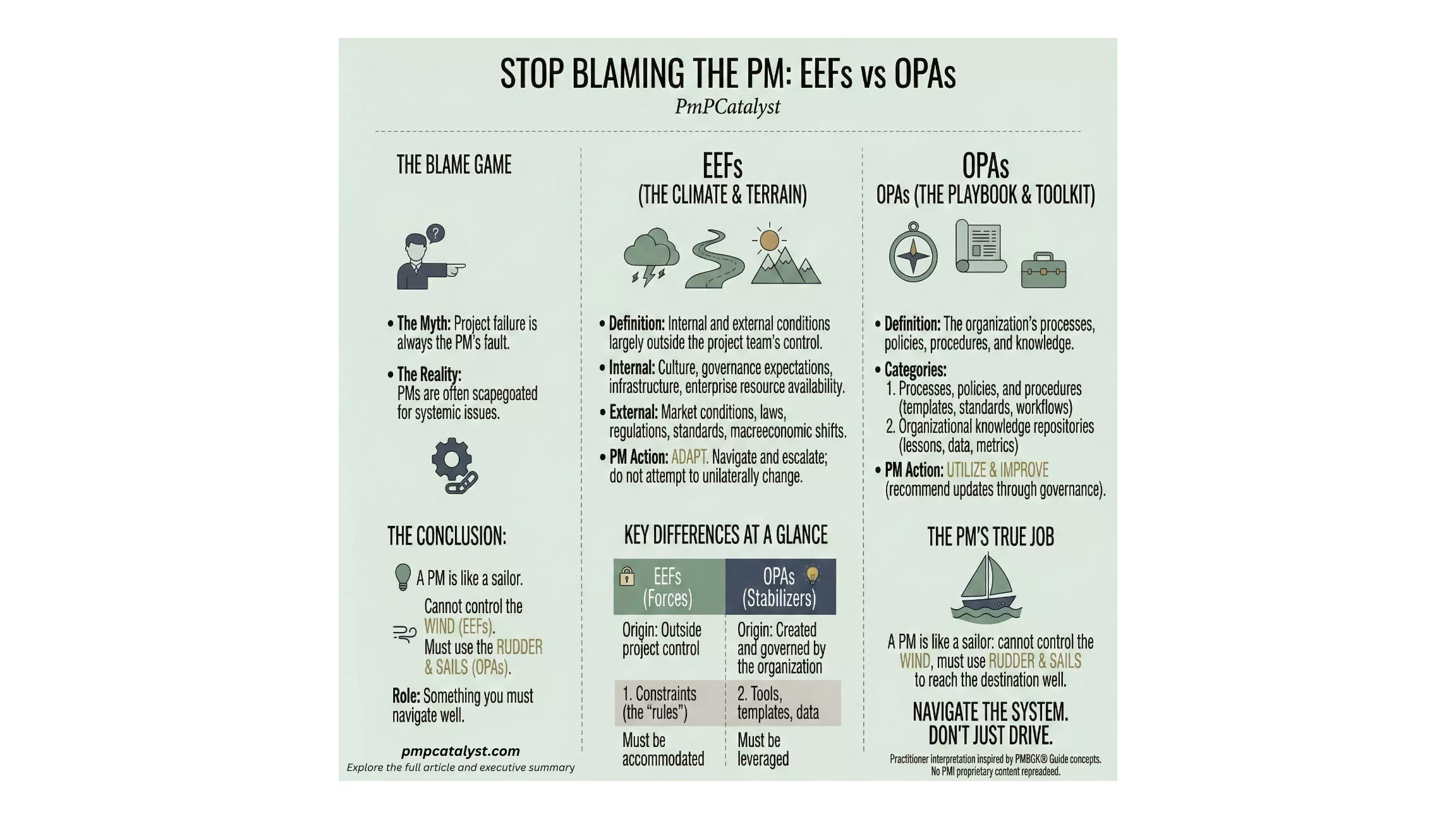
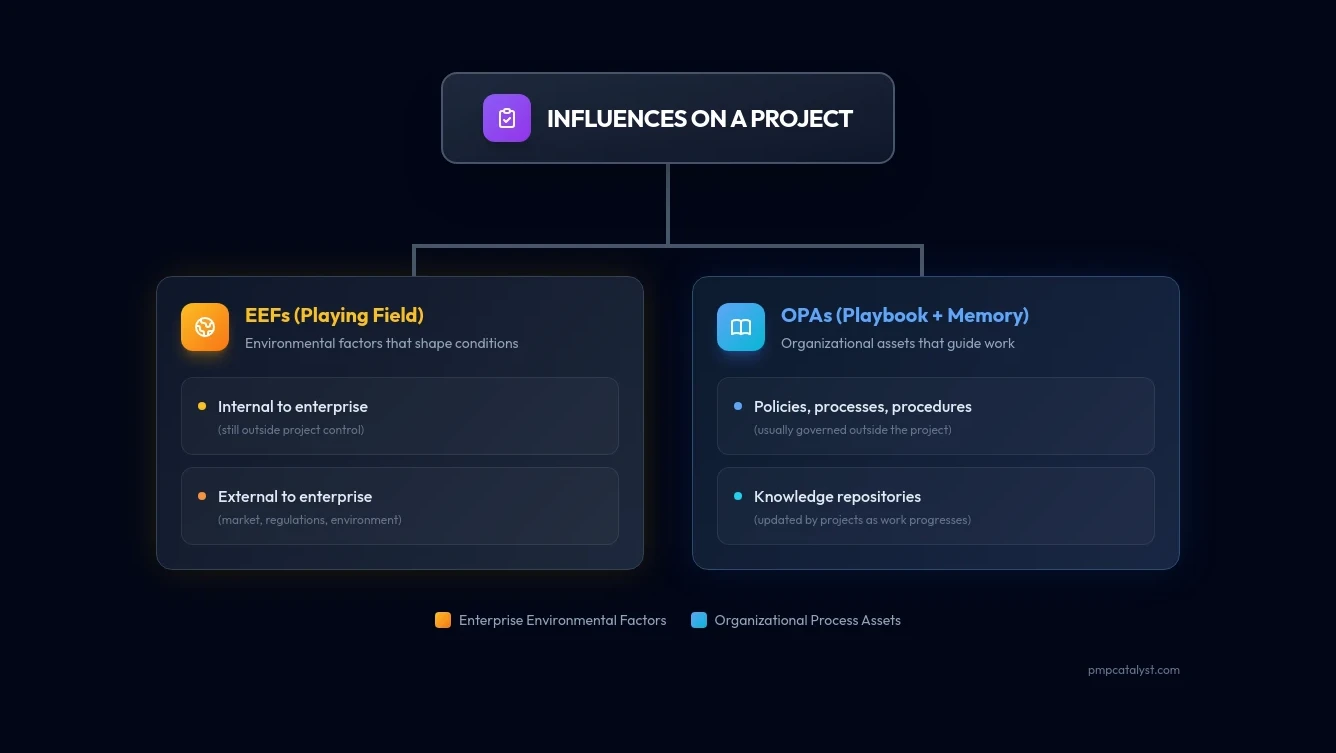
Every project is shaped by two sets of unseen ‘hidden hands’: Enterprise Environmental Factors (EEFs) and Organizational Process Assets (OPAs). Think of EEFs as the climate and terrain in which your project must operate whereby the conditions can constrain, direct, or enable the work, and OPAs as the tools, playbook, and ‘collective memory’ your organization hands you for the journey. Your job is still to drive but pretending the terrain does not matter is how projects crash and PMs get scapegoated. PMBOK 8 keeps the message blunt: environments influence planning and project work. That means you do not manage a project in a vacuum. You manage a project inside a system. EEFs and OPAs together, they create the playing field on which the PM performs and each capable of pushing the project in a favorable, neutral, or unfavorable direction. The distinction between EEFs and OPAs matters when you write about roles and accountability. It protects the PM from being blamed for not controlling what they do not own. Let’s break down each one in plain language:
Enterprise Environmental Factors (EEFs): The Project Environment
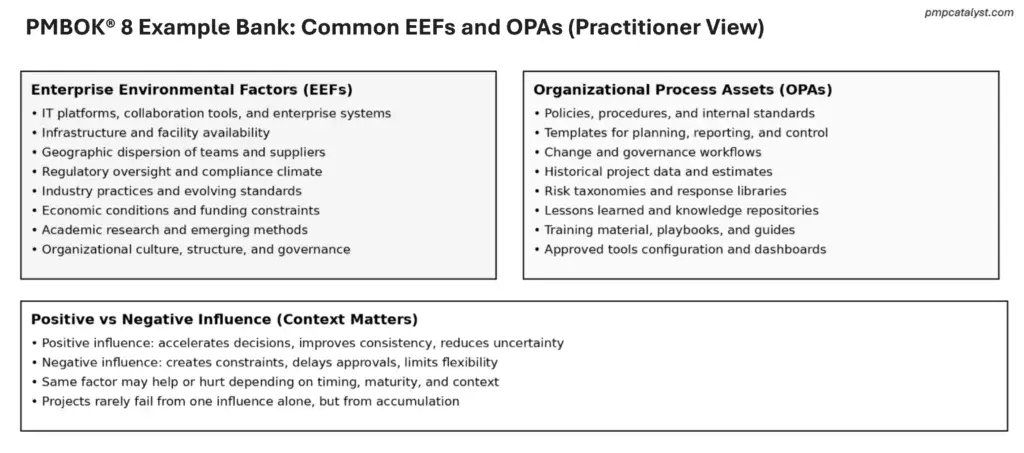
EEFs are the conditions and constraints that exist around your project. Crucially, they’re not under the immediate control of the team. EEFs are the givens, the context you inherit. Some are external to the organization (think government regulations, market conditions, industry standards, economic trends, climate events, political stability). Others are internal to the organization (think company culture, organizational structure, internal policies, available infrastructure and resources). The PMBOK® Guide 8th ed emphasizes this internal vs external breakdown: internal EEFs might include your company’s hierarchy, decision-making style, or the project management system you’re stuck with; external EEFs might include new laws, competitors’ actions, or supply chain disruptions.
What all EEFs have in common is that the project team has little or no direct influence over them. You can’t wish away a government policy or single-handedly change your company’s culture. At best, you adapt to EEFs, mitigate their risks, or capitalize on their opportunities. EEFs often act as constraints or drivers since they limit what you can do or shape how you must do it.
A few quick examples: a strict regulatory requirement (external EEF) might impose additional testing steps on your project; a dysfunctional internal approval process (internal EEF) might delay every decision; a booming market (external EEF) might flood your project with change requests, while a resource freeze (internal EEF) might force you to get by with a smaller team.
In short, EEFs are the environmental realities your project has to live with. They can help or hinder your project in significant ways, but you can’t pick them, they’re part of the hand you’re dealt.
In a nutshell, EEFs are conditions; they are the state of the world or environment around the project, including the organization and outside it. EEFs are what you are dealing with. EEFs are the playing field with conditions not under the immediate control of the project team that can constrain, direct, or enable the work.
EEFs updates
When EEF updates appear as outputs (for example in Acquire Resources and Lead the Team), think of them as: The project triggered a change in internal conditions (tools, access, onboarding, staffing model, collaboration setup), and the enterprise implemented it. Or the project identified a meaningful change in the environment and ensured it is reflected in the enterprise context (governance, constraints, operating model assumptions). In other words: the PM doesn’t “update culture.” But the project can expose a constraint so clearly that the organization changes something around it.
Organizational Process Assets (OPAs): The Institutional Knowledge and Tools
If EEFs are the climate and the terrain, OPAs are the guidebook and toolkit your organization provides. OPAs are internal assets; basically any specific knowledge, process, or resource that your organization has built up over time to help manage projects. Unlike EEFs, OPAs can be shaped by the team when they are guidance or recommended standards, but when they are mandatory organizational requirements, the team’s role is compliance, not control especially for policies, procedures, and regulations. If they are optional guidance, you can not only use them but also tailor them and often you can even update or improve them as the project progresses. If they are mandatory, you follow them and escalate changes through governance. In essence, part of OPAs i.e. the policies, processes, procedures, and standard templates, the team can tailor them and/or propose improvements. Think of OPAs as the collective memory and procedures of your company: templates, guidelines, historical data, lessons learned, standard operating procedures, checklists, databases, and so on. They are the documents and processes that your organization has decided to formalize, because presumably they make projects more repeatable or successful.
OPAs are internal to the organization: they are the organization’s reusable ways of working and stored knowledge. What did change across editions is the packaging. PMBOK 6 taught OPAs in two buckets (processes/policies/procedures and corporate knowledge base) alongside EEFs (internal/external).PMBOK 7temporarily collapsed the discussion into internal environment and external environment, where internal environment blended OPA-type assets (process, data, knowledge, governance artifacts) with internal EEF-style conditions (culture, structure, infrastructure, capability). PMBOK 8 returns to the explicit EEFs-versus-OPAs distinction again, without changing the core idea from PMBOK 6 but if you learned OPAs from PMBOK 6, what it called the Corporate Knowledge Base is what PMBOK 8 now calls Organizational Knowledge Repositories; same idea, updated wording.
The first category (i.e. Processes, Policies, and Procedures) includes all those formal or informal ‘rules of the road’ for projects: methodological guidelines, standard workflows, procurement policies, approval matrices, quality check processes, project governance frameworks, even corporate HR or safety policies that project teams are expected to follow. These are usually established by a PMO or another governing body and provide a ready-made process for the team. They might be mandatory or just recommended, but either way they shape how you plan and execute the project.
The second category, knowledge repositories, is basically your organization’s memory bank. This includes historical project files, lessons learned databases, risk registers from past projects, project calendars, technical documentation, and metrics from previous initiatives. These assets let you learn from the past and avoid reinventing the wheel. For example, before you start a new project, you might pull up a similar project’s schedule and budget performance (an OPA) to calibrate your estimates, or reference a lessons-learned repository to see what pitfalls to avoid. During execution, you might follow a communication plan template or change request form that’s pre-approved by your organization (OPAs), and at closing you’ll add your own lessons learned to the repository (updating the OPA for future teams).
In essence, OPAs are the internal knowledge and process toolkit that you can leverage and even influence. Unlike the fixed constraints of EEFs, OPAs are meant to be used and updated by project teams. In fact, many OPAs get better over time precisely because PMs contribute their experiences back, e.g., refining a template or adding a lesson learned. Where EEFs often limit a PM’s options, OPAs exist to expand a PM’s options by providing established practices and information. One way to remember: EEFs are conditions that shape your options and OPAs are internal assets that shape your execution. Remember only that, and you’ll already manage better than most teams.
Why does this matter? Because recognizing what’s an EEF vs an OPA in a given situation helps you understand whether you must adapt to it or can actively shape it. Is a project stumbling because of an unpredictable new law or market crash (EEF)? Or is it because the team didn’t use available historical data and followed no process (OPA issue)? Does a delay call for escalating an external issue to sponsors, or updating an internal process to prevent recurrence? Knowing the difference guides your response and helps you defend your project when the post-mortem starts hunting for culprits. It’s also essential for PMP exam success (expect scenario questions about what’s within the PM’s sphere of influence vs. what isn’t). We’ll debunk more on that later. First, let’s see how EEFs and OPAs concretely show up across the project management focus areas (formerly known as Process Groups a key factor and actions/activities in the project lifecycle), from the first idea of a project all the way to the final close-out.
OPAs updates
OPAs behave in two different ways: – Policies, processes, and procedures Usually created and governed by PMO, quality, finance, HR, procurement, or leadership. Projects can tailor within limits, but they do not rewrite these as part of delivery. – Organizational knowledge repositories These are meant to be updated by projects continuously: lessons learned, metrics, issue and defect logs, historical schedules, earned value data, cost performance information. So when you see “OPA updates” as an output, it often means “we updated the repositories,” not “we rewrote corporate policy.”
How EEFs and OPAs Shape Project Life Cycle Through the 5 Focus Areas
The fastest way to stop confusion (and stop unfair blame) is to separate how the work is staged from how the project is managed. A project life cycle may be split into phases like feasibility, design, build, test, deploy, and close. Those are delivery stages that culminate in tangible deliverables or outcomes. But Initiating, Planning, Executing, Monitoring and Controlling, and Closing are not life cycle phases. In PMBOK 8, they are Project Management Focus Areas: the fundamental actions that happen across the project, often iteratively or in parallel or overlapped, and inside each life cycle phase. That distinction matters because EEFs and OPAs don’t hit once per phase. They show up repeatedly, and they often explain why a PM gets blamed for outcomes that were shaped by the environment and the organization long before the schedule slipped.
Initiating Focus Area: where the project inherits its reality
Every project begins somewhere and that somewhere is usually within a larger organizational and environmental context. In theInitiation focus area, you’re defining what the project is and securing approval to proceed (think project charter and stakeholder identification). Here, EEFs are often front-and-center. You might be responding to anexternal EEF like a new regulatory requirement or market opportunity that prompted the project in the first place. For example, imagine you’re chartering a project to develop a new medical device because updated government safety standards (external EEF) mandate redesign. Your charter’s justification and requirements will be heavily shaped by that law. Or perhaps the project is initiated because of an internal EEF: a CEO directive or a strategic shift due to internal business conditions. Either way, those environmental factors drive why the project exists and what constraints it faces from Day one. As a PM, you can’t change those factors, you must acknowledge them. An astute project sponsor will explicitly reference them in the project charter (e.g., “This project is in response to FDA Regulation XYZ…”).
On the flip side, OPAs provide vital support in initiation. You’re likely not writing that project charter from scratch. You’ll have organizational templates and processes to follow. Most companies have a standard project charter template (an OPA) that ensures you include all necessary information and get the right approvals. You might also havehistorical project data (another OPA) to draw upon: for instance, lessons learned from a similar past project could warn you about pitfalls in initial scoping. Even the process of “go/no-go” decision-making for new projects is often governed by organizational process assets. For example, if your company has a formal project governance framework for initiation, that is an OPA: a defined procedure for evaluating proposals, involving certain gatekeepers, and requiring specific criteria to be met. (If that governance is lacking or weak, it’s also telling as I noted in a related article, when governance is poorly defined at kickoff, no amount of effort later will fully recover the project pmpcatalyst.com. A robust governance process is an asset that sets you up for success.)
Real-World Example (Initiation):
A telecom company is considering a project to roll out 5G infrastructure in a region. External EEFs at play include government spectrum licensing rules and local regulations on tower installations. These will constrain where and how the project can proceed. Internal EEFs include the company’s current network capacity and organizational risk appetite for cutting-edge tech. OPAs available? The company’s PMO provides a pre-approved business case and project charter template, along with a knowledge repository of past network upgrade projects. The PM uses the template to ensure all necessary analysis (like regulatory compliance steps) are documented, and checks the lessons learned repository for any issues faced during the last infrastructure rollout. Armed with that knowledge (OPA) and an understanding of the regulatory landscape (EEF), the PM drafts a charter that realistically frames the project. If leadership approves, the project moves forward with eyes open.
Key takeaways (Initiation):
In Initiating, the project is authorized and aligned. This is where the project inherits the biggest constraints before anyone even says “baseline.”
EEFs show up as the conditions that define what is possible: governance appetite, decision speed, strategic priorities, regulatory context, market pressure, internal capacity constraints. Many of these are outside the project even when they’re inside the enterprise (culture, structure, availability).
OPAs show up as what the organization uses to formalize the start: charter templates, approval workflows, stakeholder register templates, initiation checklists, and any historical context you can pull from prior work.
If the project starts with unrealistic commitments because of environment pressure or weak governance, that’s not a ‘PM leadership’ problem later. It’s a system problem that was planted early.
Planning Focus Area: where EEFs and OPAs shape every choice
During Planning, the project manager and team formulate how to accomplish the scope within the given constraints. Planning is where we decide what constraints are real, what tailoring is allowed, what governance we must follow, what ‘good’ looks like in this organization, how we will baseline, measure, and control. You cannot plan in a vacuum. You plan inside a company, inside a market, inside a set of rules, tools, cultures, and past scars. Here you’ll see an abundance of both EEFs and OPAs influencing the process. In fact, nearly allplanning processes in PMBOK list EEFs and OPAs as inputs, which makes sense, because you’re crafting a plan that must consider the environment you’re in and use the best organizational knowledge available.
On the EEF side, internal EEFs like organizational culture, structure, and existing systems can shape your planning approach. Is your organization high-tech and geographically dispersed? That will affect your communication plan (perhaps you need to plan around multiple time zones and rely on certain collaboration tools). Does the company have a risk-averse culture with low tolerance for uncertainty? That might require a more detailed risk management plan and extra approvals for any contingency spending. External EEFs during planning might include things like the weather if you’re planning a construction schedule (e.g., extreme cold, frozen ground, high winds, heat waves are all factors), or market conditions that influence procurement (if a certain material is scarce or volatile in price, you plan your procurements accordingly). A classic example: planning for a project during a pandemic had to account for external EEFs like lockdown policies and supply chain disruptions; totally outside the PM’s control, but absolutely necessary to consider when scheduling work or budgeting for costs (PPE, site safety measures, delays, etc.).
Meanwhile, OPAs are a planner’s best friend. The organization likely provides standard templates and procedures for all key plans: a risk register template, a work breakdown structure guideline, a project management plan template, estimating policies, etc. All those are OPAs and should be utilized to save time and align with company standards. For instance, if you’re planning the schedule, an OPA might be your organization’s standard estimating guidelines and historical schedule data from similar projects (typical activity durations, productivity rates, and calendar assumptions) that you reuse to build a more realistic baseline. Historical information OPAs (like past project schedules, cost data, and lessons learned) can make your planning far more realistic. Smart PMs dig into the archives: “How long did a similar project actually take to do design? What pitfalls did they record?” That information can be factored into your schedule and budget planning. OPAs essentially give you recipes and historical insights so you don’t plan in a vacuum.
During planning, you also encounter EEFs and OPAs intersecting. For example, your company’s policies and procedures might dictate some planning elements. Is that an OPA or an internal EEF? Here’s where confusion can arise. A company policy (say, “All projects above $1M must undergo peer review”) is internally created, documented, and controllable by the organization, so it’s technically an OPA (process/policy). But it functions as a constraint on your project (internal environmental factor) because as the PM you can’t change it at will. If you’re preparing for the PMP exam, questions usually aren’t about tiny semantic differences, they’re about whether you can interpret the scenario and pick the option that aligns with PMI’s intent and the information given. In practice, the distinction matters less than knowing you must incorporate it. For planning purposes, it’s an input you just accept. If it’s documented and formal, call it an OPA; if it’s more about culture or a norm, it might be an EEF. For instance, a code of conduct: if it’s a published company policy, it’s an OPA asset; if it’s the unwritten “this is how people behave here” culture, it’s an internal EEF. The key is, both EEFs and OPAs are present in planning to shape your choices, one by imposing context, the other by offering guidance.
Real-World Example (Planning):
You’re planning a large software implementation project. EEF influences: The client’s industry is highly regulated (external EEF: you must build compliance tasks into the plan), and your own company has a very matrixed organization structure (internal EEF: resource availability will depend on functional managers’ approval, which affects your resource management plan). OPAs at hand: your PMO provides a scope statement template and a risk checklist from previous similar projects. You use the checklist (OPA) to identify regulatory risks early. You also consult the lessons learned repository for that industry, finding that “client sign-off delays” were a common issue last time. That insight (OPA) leads you to include additional buffer in the schedule and a clearer sign-off process in the communications plan. Throughout planning, whenever an assumption or constraint pops up, you tag it: is this rooted in an external factor we must live with (like “All work must follow GDPR data rules”, that’s EEF), or is it something we have internal guidance on (like “Use the company’s Agile methodology playbook”, that’s OPA)? By sorting that out, you ensure your plan is both compliant with reality (EEFs) and leveraging best practices (OPAs).
Key takeaways (Planning):
Planning is where the project’s “course of action” is defined and refined, often through progressive elaboration, feedback loops, and rolling wave planning.
EEFs matter heavily here because planning is adaptation to reality: tooling constraints, resource availability, procurement lead times, standards, legal requirements, market volatility, stakeholder expectations, organizational politics.
OPAs matter heavily because planning should not start from scratch: estimating databases, risk checklists, templates, tailoring guidelines, change control rules, work authorization procedures, and lessons learned repositories.
Most PMP confusion happens here because PMP candidates memorize lists rather than seeing the logic:EEFs constrain and direct the plan; OPAs enable and standardize the plan.
Executing Focus Area: The Plan Meets Reality (and the PM Gets Blamed)
The Executing Focus Area is where the work actually gets done: building the product, writing the code, constructing the facility, configuring the system, producing the units, commissioning the equipment. And it’s also where the blame narrative usually starts. Stakeholders see visible progress, visible delays, visible cost burn, and the easiest story to tell becomes: “the PM should have managed better.”
But execution is not a closed room where your plan runs in peace. Execution happensinside a moving environment, and that environment has power over the project whether you like it or not. In PMBOK language, this is where EEFs throw friction into the system, and OPAs either stabilize the work or choke it, depending on how mature they are.
External EEFs often hit hardest during execution because the outside world does not pause for your baseline. A regulation can change, a permitting interpretation can shift, tariffs can appear, inflation can spike, or a critical supplier can fail. Imagine being halfway through a construction job and new environmental legislation suddenly restricts a material you already specified. Nothing about that is under the project’s control, but compliance is not optional. Scope changes, procurement pivots, schedule rework, and cost impacts follow. The PM didn’t “cause” the external event, but the PM still becomes responsible for translating that event into decisions, tradeoffs, and recovery actions.
Internal EEFs can be just as disruptive, but they are easier to misread because they don’t look like risk events. They look like normal life inside the company. Your structure, culture, governance expectations, and decision latency all shape how execution really runs. In a functional organization, execution can feel like daily negotiations for the same people and the same equipment. In a high-trust culture, issues surface early; in a blame culture, issues get hidden until they explode. Even the technology environment matters: trying to execute with weak collaboration tools, fragmented data, or an inefficient PMIS becomes an execution constraint, not a productivity problem.
This is also where people mix up OPAs and internal EEFs, because the line can feel blurry on the ground. Take a situation like: “All production changes must go through a Change Control Board that meets monthly.” The procedure and forms are OPAs (the organization’s defined way of doing change control). But the governance cadence and decision speed is an internal EEF reality that shapes execution flow. Same topic, two different lenses: the rulebook is an asset; the organizational behavior around that rulebook is the environment.
OPAs are the stabilizers execution depends on. Standard operating procedures, quality assurance routines, issue and defect workflows, templates, reporting conventions, and work authorization practices are the ‘rails’ that prevent execution from turning into improvisation. When these assets are mature, execution becomes repeatable. When they’re weak, execution becomes heroic, and heroism is a terrible operating model.
Now, here’s the nuance most practitioners miss and the one I will explicitly highlight: in the PMBOK 8 process tables, EEF updates show up as explicit outputs only in Acquire Resources and Lead the Team (Resource performance domain). That does not mean EEFs don’t matter elsewhere in execution. It means PMI is being precise about where the project most directly triggers changes to enterprise conditions. When you acquire resources or lead the team, the project often forces the enterprise to adjust things like access rights, tool licenses, environments, collaboration technology, onboarding paths, workspace arrangements, or availability rules. The PM and team can identify the need, escalate it, and drive it through governance, but enterprise functions (HR, IT, Facilities, PMO) typically own and implement the change. In that sense, the “EEF update” is overwhelmingly an internal enterprise condition being modified or formally recorded. External EEFs can change, but the project doesn’t “update” them; it updates its plans, assumptions, and responses to adapt.
A simple real-world execution scenario makes this concrete:
You’re running a marketing campaign and the platform algorithm shifts mid-stream (external EEF), knocking your engagement assumptions sideways. At the same time, Legal introduces new mandatory review steps after a PR incident (internal governance expectation). Both changes slow work, both are largely outside the team’s direct control, and both will be felt as execution pain. What keeps the project from spinning is your OPAs: the decision path for change control, the templates for documenting impacts, the issue and action tracking discipline, and the knowledge repository that lets you reuse what worked last time a similar disruption happened.
Key takeaways (Execution):
Execution is where the plan meets the real world i.e. reality, and reality is shaped by forces bigger than the PM. The job isn’t to pretend those forces don’t exist. The job is to surface them early, translate them into decision-ready impacts, and use organizational assets to keep delivery stable.
EEFs show up as friction and disruption: sudden supplier instability, regulatory interpretation changes, labor constraints, internal approval delays, tool limitations, distributed teams, shifting stakeholder power.
OPAs show up as stabilization mechanisms: standard procedures, quality assurance methods, issue and defect management processes, procurement templates, and the organization’s communication and reporting conventions.
Execution is also where “blame the PM” becomes loudest because symptoms are visible. But many execution problems are simply EEFs and OPAs finally revealing themselves as constraints.
Monitoring & Controlling Focus Area: The Referee Between Plan and Reality
During Monitoring and Controlling, the project manager is tracking performance, managing changes, and ensuring the project stays on course (or course-corrects as needed). In this focus area, EEFs often provide the benchmarks and parameters for what “on track” means, while organizational assets provide the methods and metrics for doing the tracking.
EEF influences in Monitoring and Controlling can be subtle but decisive. Stakeholder risk tolerance, governance expectations, and organizational culture (internal EEFs) shape how variances are interpreted and escalated. In one organization, a 5% cost variance triggers immediate executive attention; in another, it is managed at the team level. The external environment also continues to matter because regulatory shifts, market moves, geopolitical events, and technology changes can introduce new risks or invalidate assumptions midstream. Practically, this shows up in two places: within PMBOK-aligned monitoring work (for example, monitoring risks and reviewing assumptions as conditions evolve), and in the new PMP exam expectations, where the Business Environment domain emphasizes evaluating external environmental changes and translating them into scope, schedule, and cost decisions.
One interesting nuance: not all processes in monitoring & controlling list EEFs as inputs. In fact, some controlling processes are about strictly internal matters. For example, consider Monitor and Control Resourcing process (monitoring and controlling physical or virtual resources availability and usage as planned). The PMBOK Guide 8th Edition lists OPAs as an input there, but not EEFs. The logic being that managing your project’s resource consumption is an internal control issue where organizational procedures and data (OPAs) are relevant, but broader environmental factors don’t directly come into play. The PMP exam might expect you to notice things like that. It signals that when you’re controlling resources, you should focus on internal processes (e.g., inventory systems, resource assignment matrices that are all OPAs) rather than external factors. Practitioner focus: if a process lists only OPAs as inputs, it implies you have all the data and control you need internally; it’s about following and updating organizational procedures. In our example of Control Resources, you’d be guided by OPAs like the company’s resource management system (perhaps an internal database of equipment and where it’s allocated) and the procedures for reallocating or releasing resources. There’s no new external factor to account for at that point. It’s about using internal organizational info to ensure resources are where they should be. (In contrast, an earlier process like Estimate Resources did involve EEFs, e.g., the labor market conditions or the organizational HR policies might affect how you estimate needs but once you’re simply controlling those resources day-to-day, it’s an internal game.)
OPAs in monitoring and controlling are all about methods, metrics, and reporting. You will lean on organizational standards for what to measure and how to measure it. For instance, your company might have a standard status report format or dashboard (OPA) you must use, and thresholds for red/yellow/green status. There may be pre-defined KPIs and quality metrics to monitor. The Project Management Information System (which could be considered an internal EEF) will be configured with certain fields and workflows, essentially embedding OPAs (like report templates, issue management processes) into the tool. Another OPA: change control procedures. Most organizations have a standard change control process (often overseen by a Change Control Board with specific forms and approval steps). That is a classic OPA (a process/procedure asset) that you execute during monitoring & controlling whenever a change is deemed necessary. If, say, a new EEF pops up (“surprise, a new competitor product was just launched, we might need to change our requirements”), you’ll use the OPA change process to handle that pivot formally.
Monitoring and Controlling is where the project generates a lot of governance “trace,” but PMBOK 8 is precise about what it labels as an OPA update versus a project document / plan update. As performance is tracked and issues are resolved, teams update project records such as the issue log, forecasts, and the lessons learned register. Those artifacts strengthen organizational learning over time, but they are typically treated as project document updates in the process tables. In the Monitoring and Controlling Focus Area, OPA updates are explicitly listed as an output in Monitor Risks, while most other Monitoring and Controlling work results in project management plan updates, project document updates, work performance information, and work performance reports (for the latter it is specifically from Monitor and Control Project Performance process). The practical takeaway is the same: when reality shifts, you update the plan and project documents, and you preserve durable learning so it can be transferred into organizational repositories at closure.
Real-World Example (Monitoring & Controlling):
You manage a software project and you’re in the testing phase and doing Monitoring and Controlling work to detect defects and schedule slippage. Your organization’s definition of acceptable quality (internal EEF) dictates that no more than 5% of test cases can be critical defects. This guides your monitoring of quality metrics. At the same time, you’re using anorganizational dashboard tool pre-set to show test progress, and it uses a red/yellow/green scheme based on thresholds defined by the PMO. The tool is typically an internal EEF (enterprise system), while the configured fields, workflows, templates, and thresholds embedded in it are OPAs (organizational standards). Mid-way, you see the trend of defects is higher than 5%. That triggers a standard issue escalation process (OPA procedure) to notify the sponsor. While investigating, you recall a similar project had a spike in defects at this stage; you pull up that project’s lessons learned and find that the root cause was a particular third-party module. That historical insight (OPA) helps you pinpoint the problem faster, indeed your project uses the same module. Now for changes: you raise a change request (following the OPA change control process) to swap out that module for a different solution. The Change Control Board, guided by organizational governance rules (OPA), approves it. You document this in the change log and also update the lessons learned register (a project document), which is later transferred into the organizational knowledge repository during closing. Throughout, external EEFs like market demand or new tech standards might also be watched perhaps if a new version of a development framework is released (external EEF), you decide whether to incorporate it or not via change control. In monitoring & controlling, you’re essentially playing referee between the plan vs reality, using organizational metrics and processes to judge the game, and keeping an eye out for external game-changers as well.
Key takeaways (Monitoring and Controlling):
Monitoring and Controlling runs in parallel with the other Focus Areas (mainly execution), within each life cycle phase and for the project as a whole. This is where performance is measured, variance is analyzed, and changes are initiated. Monitoring doesn’t update the world outside your project; it updates your understanding of it and the organization’s ability to respond next time.
EEFs still influence what good looks like: tolerance for variance, stakeholder risk appetite, regulatory oversight intensity, and the quality of enterprise systems feeding performance data.
OPAs often dominate the mechanics because control work is procedural: dashboards, reporting formats, metrics definitions, control thresholds, and the organization’s integrated change control rules.
In PMBOK 8’s Monitoring and Controlling Focus Area, the pattern is clear: OPAs show up almost everywhere because monitoring and control is built on internal governance routines, standard metrics, and disciplined record-keeping. In fact, OPAs are inputs to 9 out of 10 Monitoring and Controlling processes, while EEFs are inputs to 7 out of 10. Even more telling, EEF updates do not appear as outputs in this Focus Area, while OPA updates appear in only one process: Monitor Risks. The message is subtle but important: monitoring is less about ‘changing the environment’ and more about using organizational systems to detect drift, interpret it through governance expectations, and feed learning back into the organization especially through risk monitoring.
Closing Focus Area: Where Learning and Transfer Decide Whether Value Survives
In theClosing phase, the project (or project phase) is formally closed out. By this point, most EEFs have already had their impact and most OPAs created or used have been updated. During closing, the emphasis is on finalizing all activities, obtaining formal acceptance, and capturing lessons.
EEFs in closing are usually about compliance and final transitions to the broader environment. An external EEF might be any regulatory sign-off or audit requirement that must happen at project end, e.g., a government compliance audit that’s mandatory to consider the project officially closed. If you delivered a product that needs a certification from an external agency, that’s an external environmental factor to account for in closure. Internal EEFs could include organizational requirements like an internal audit, or simply the organizational structure determining who now takes ownership of the project deliverables (for instance, an operations team under a certain department). By closing, you shouldn’t be blindsided by new EEFs. Ideally, you identified them all earlier. Closing is more procedural and less about adapting to new external stuff (if a new external factor emerges at the 11th hour, it might even push you back out of closing!).
OPAs are extremely important in closing. This is where you turn your project’s experience into organizational knowledge. Key OPAs in this phase include the final lessons learned repository updates, final project reports, and archival of all project documents in a knowledge base (all of which are OPAs for future use). Most organizations have a checklist or procedure for closing (an OPA). For example, a project closure checklist that ensures you’ve gotten all approvals, handed off all deliverables, released resources, and documented everything necessary. You’ll be guided by that to not miss anything. There might also be an OPA regarding post-project evaluations or benefits tracking. Maybe your PMO requires a post-mortem meeting or a benefits realization report 6 months after closure. These are part of the organizational process asset framework ensuring projects don’t just fade away but formally close and yield learnings and value.
In essence, closing is about updating OPAs and fulfilling any environmental or contractual end conditions. The project manager’s influence here is in making sure the project’s story is properly recorded. You can’t change the fact that perhaps the market shifted and killed the project’s original value (EEF) but you can document why decisions were made and how EEFs affected outcomes, so that context isn’t lost. This protects future PMs from being blamed for the same unexpected external hit, because now it’s in the lessons learned library for all to see.
You’ve completed a software implementation. In closure, anEEF you must satisfy is a contractual obligation (external EEF) to have an independent security audit confirm the system meets standards. You schedule that audit and ensure the results are passed to the compliance department. Internally, your organization has a project closure procedure (OPA) which you follow: you obtain formal sign-off from the client (using the sign-off form template, an OPA), you release the project team members per HR guidelines (internal EEF: the resource managers need official notice), and you archive all project documents on the company’s SharePoint knowledge repository (OPA). Crucially, you hold a lessons learned session with the team and stakeholders. In that meeting, a lot of discussion revolves around how certain unexpected events affected the project. For example, “Mid-project, our competitor launched a similar product which changed our scope” (an external factor). You capture those insights, attributing outcomes appropriately to those causes. These lessons are then added to the organizational lessons learned repository (OPA) with tags like “market competition” and “scope change management”. Later, when another PM starts a similar project, they might see your project’s closing notes and be aware of those potential external factors. By rigorously updating OPAs at closing, you essentially arm the next project team with knowledge. And by recognizing the role of EEFs in your final report, you paint a fair picture of performance, which helps counter any unfair ‘the PM failed’ narratives by showing context.
Key takeaways (Closing):
Closing is where the project, phase, contract, or even a terminated initiative is formally closed and where transfer to operations/service can succeed or fail.
EEFs shape acceptance and transition conditions: compliance requirements, safety regulations, operational readiness realities, and stakeholder politics around sign-off.
OPAs shape closure quality: closure guidelines, archival rules, and most importantly the organizational knowledge repositories that capture lessons learned, performance history, defect trends, and handover documentation.
This is where projects either contribute to organizational maturity or repeat the same failure pattern next time.
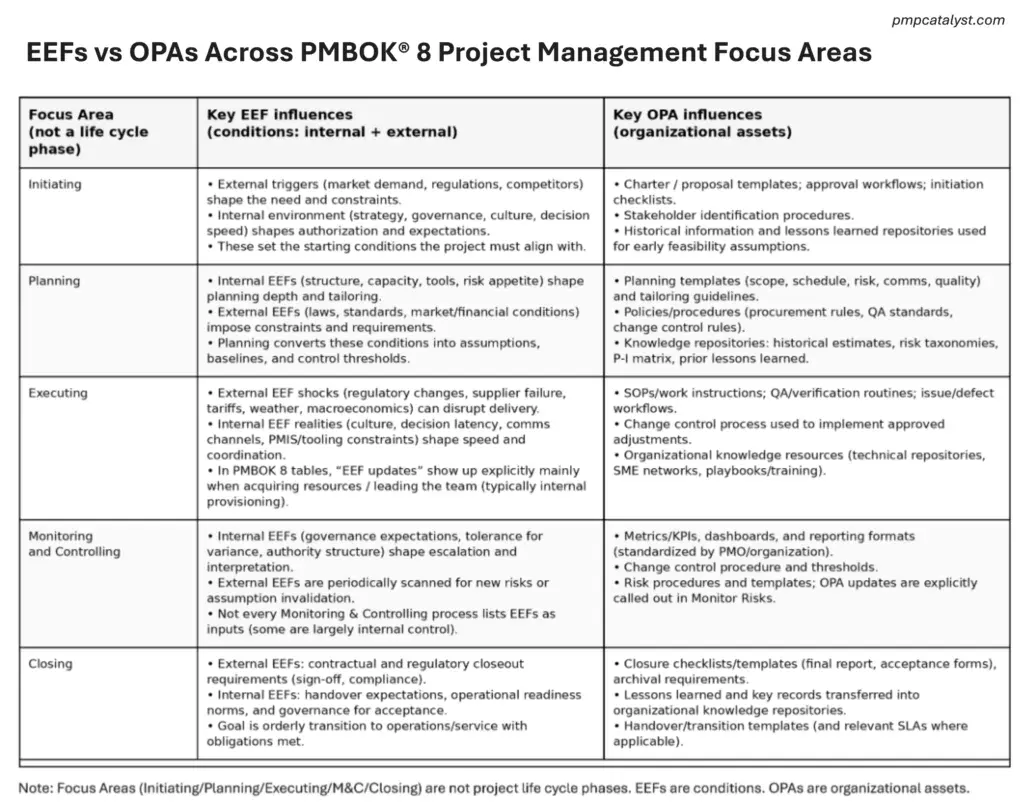
Quick Reference: EEFs vs OPAs Across the Focus Areas
Examples are paraphrased and adapted for practitioner learning and do not reproduce PMI copyrighted or proprietary content.
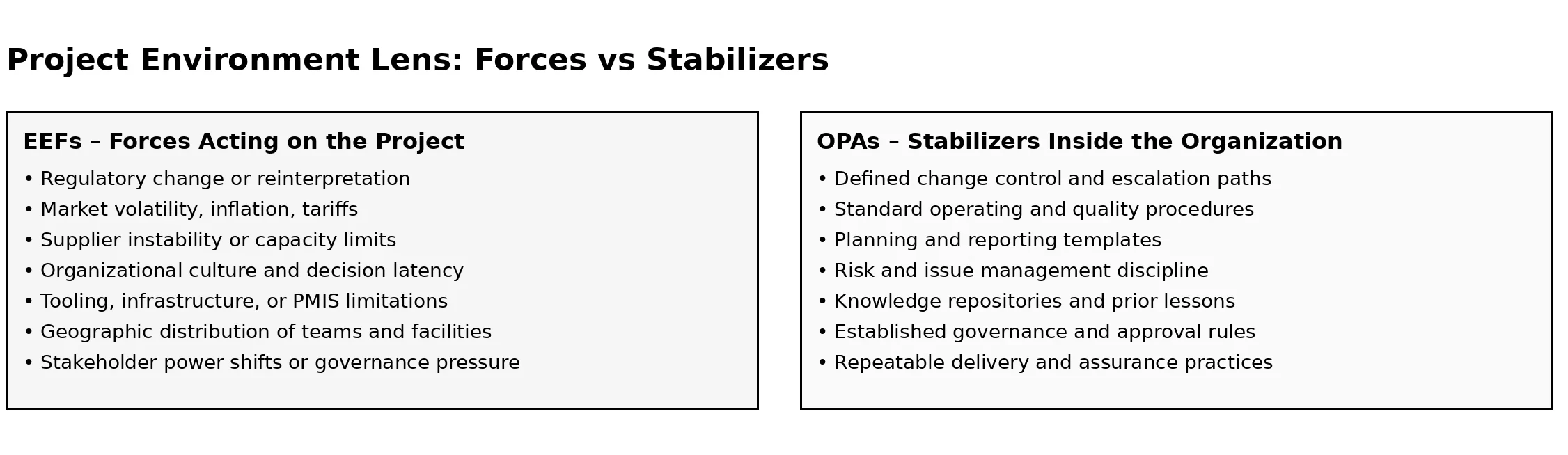
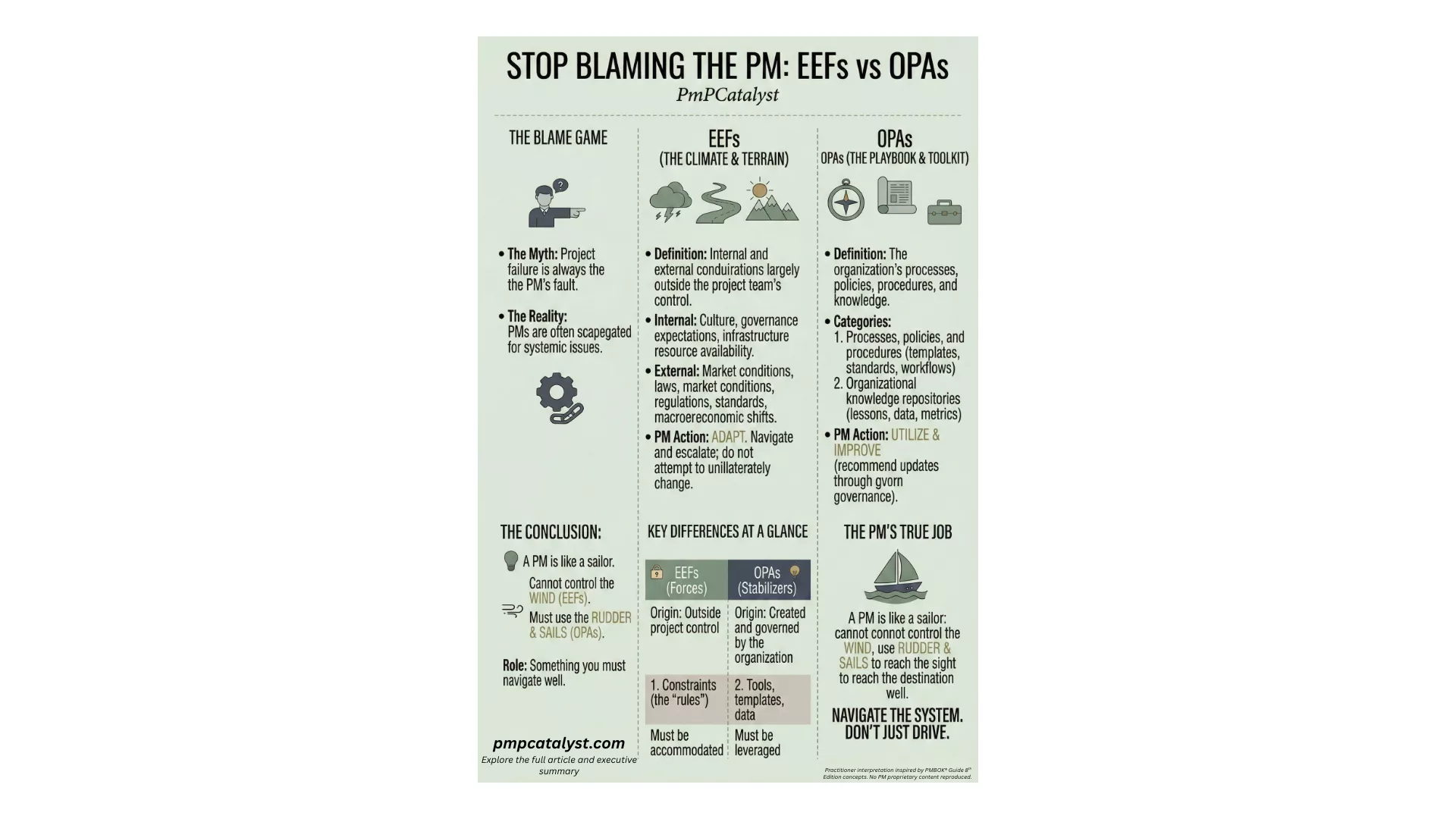
Infographic explaining how Enterprise Environmental Factors (EEFs) and Organizational Process Assets (OPAs) influence project outcomes using a forces vs stabilizers metaphor (PMBOK 8 practitioner view)
Prefer a concise reference you can keep? Download the executive summary and visual framework (PDF).
Common Confusions and Myths (Especially for PMP Aspirants)
If this still feels tricky, you’re not alone. Many PMP candidates get tripped up on EEFs vs OPAs because the boundary can feel blurry in real project life. Here are the confusions that show up the most.
“Policies and procedures: EEF or OPA?”
Here’s the clean way to think about it in a PMBOK 8 mindset. If it’s a documented organizational rulebook i.e. a process, policy, procedure, template, checklist, or standard, that is an OPA. It’s an organizational asset, even if the project team didn’t create it. The blur happens because the way that rulebook behaves in real life often looks like “the environment.” For example, the change control procedure and forms are OPAs. But the organization’s decision speed, approval culture, and governance cadence around that procedure are internal EEFs. Same topic, two different lenses: the asset is the rulebook; the environment is how the organization operates around it.
“PMIS and enterprise tools: EEF or OPA?”
Think of the platform as the environment and the content/configuration as the asset. The availability and limitations of enterprise systems, collaboration tools, scheduling systems, and work authorization systems are typically internal EEFs. They are part of the enterprise conditions the project must operate within. But the templates, workflows, fields, dashboards, and standard report formats inside those tools behave like OPAs because they represent the organization’s standardized way of working embedded into the system. Practically, you don’t need to obsess over micro-labels. The test of good judgment is whether you’re dealing with a constraint you must work within (EEF) or an organizational artifact you can leverage and sometimes improve (OPA).
The myth of the “all-powerful PM.”
One of the most damaging myths in the profession is the idea that a strong PM can control everything and is therefore responsible for every outcome. That’s not leadership, that’s fantasy. Projects operate within a system. External EEFs can shift midstream (regulations, inflation, supplier failures). Internal EEFs can quietly constrain execution (decision latency, culture, authority boundaries, tooling limits). The PM is responsible for translating these forces into decision-ready impacts, escalation, and adaptation, but not for pretending those forces don’t exist. This is part of why ‘stop blaming the PM’ isn’t an emotional plea. It’s a systems reality. In a nutshell, a strong PM can navigate constraints, a strong PM can diagnose and escalate. A strong PM can design better governance. A strong PM can build alignment. But a PM cannot outwork a broken system or environment forever. If leadership wants miracles, they need to own the environment. Mature organizations do not pretend otherwise. They design governance and resourcing to protect projects.
Why PMI bothers with EEF vs OPA at all.
The practical purpose isn’t memorization. It’s training your diagnostic thinking. If the problem is driven by an EEF, the right response is usually adaptation, escalation, contingency use, or change control, not work harder. If the limitation is rooted in OPAs, the response often involves tailoring, selecting the right template or procedure, improving the artifact, or feeding better knowledge back into the organization. The PMP exam rarely asks “EEF or OPA?” in isolation. It embeds the distinction inside “what should you do next” scenarios.
“Can EEFs ever be influenced or changed?”
Generally, project teams cannot directly change EEFs, especially in the short term. But it is not entirely black and white. External EEFs (laws, regulations, market forces, geopolitical conditions) are effectively outside the project’s control. A project does not change a regulation or a market trend within its timeframe. The only viable responses are awareness, escalation, adaptation, and formal change control. Internal EEFs, however, sit in a gray zone. They are still conditions, not assets, but some of them can be influenced indirectly through governance when a project exposes friction or constraints. Examples include resource availability rules, tooling access, onboarding paths, workspace arrangements, decision latency, or approval thresholds. The project does not own these conditions, but it can trigger enterprise action by escalating impacts through the sponsor, PMO, or steering committee. For example, a project cannot change organizational culture, but it may negotiate temporary exceptions, additional decision authority, or priority access to resources with executive support. In some cases, repeated project pain highlights a systemic issue that the organization later addresses, but that improvement is an enterprise decision, not a project output. This distinction matters. When an internal condition improves as a result of project pressure, what actually gets updated are organizational assets: revised procedures, new templates, improved onboarding material, updated guidance, or expanded knowledge repositories. Those are OPAs.
So the practical rule is:
EEFs are surfaced, escalated, and adapted to
OPAs are captured, updated, and reused
That’s why projects rarely change the environment directly, but they frequently leave the organization better equipped for the next project.
PMBOK 8 also signals a very specific nuance in the process tables: “EEF updates” appear as explicit outputs in only two places: Acquire Resources and Lead the Team (Resource performance domain). That does not mean EEFs don’t matter elsewhere. It means PMI is being precise about where projects most directly trigger changes to internal enterprise conditions such as access rights, tool licenses, environments, collaboration technology, onboarding paths, workspace arrangements, or availability rules. The project team identifies the need and drives it through governance, while enterprise functions (HR, IT, Facilities, PMO) usually own and implement the change. External EEFs can shift during the project, but the project does not update them, it updates its plans, assumptions, and responses.
For PMP exam takers, remember this: EEF updates = internal enterprise condition changes (rare, explicit), while most of the time you adapt the plan and capture learning as OPAs.
So What Can a PM Do? Managing EEF and OPA Influence in Practice
Understanding these forces isn’t just theory, it’s crucial for real-world project management credibility. Here are somepractical guidelines for project managers (and aspirants) to manage, document, or escalate the influence of EEFs and OPAs on their projects:
At project start, identify key EEFs and OPAs:
As part of your environmental analysis, treat it like stakeholder analysis. What aspects of the environment could help or hurt? What assets can you tap into? For example, early in initiation or planning, make a list: regulatory requirements, market conditions, corporate standards (EEFs), and available templates, historical data, expert networks (OPAs). This could go into your project charter or project management plan as assumptions/constraints and resources. By explicitly acknowledging them, you set realistic expectations. If you know, say, that “the company’s fiscal year-end freeze will halt spending in Q4” (internal EEF), you incorporate that into the schedule and communicate it. If there’s a great repository of risks from similar projects (OPA), you plan time to review it with your team.
Leverage OPAs all the way:
They are there to make your job easier and your project more robust. Don’t reinvent documents. Use the templates (and ask if none exist!). Don’t guess on estimates if historical data is available. Dig it up. Follow the organization’s processes (they often exist because someone learned the hard way that it’s needed). During execution, use the reporting tools and issue logs provided. This not only saves time, it shows organizational alignment. Also, by using OPAs you ensure you’re contributing back to them when you update. If your organization has a weak OPA in some area (e.g., no formal risk register template), consider creating one as you go, that can be a contribution you make for future projects (If you want a simple template to start with, reach out to me on pmpmastery.com). I insist, you don’t need to copy paste templates blindly if they create confusion. Tailor it openly and document why. You’re not being a rebellious, You’re being responsible. OPAs are meant to accelerate decision and reduce ambiguity. PMP exam tip: a project manager who proactively uses OPAs in scenarios is usually doing the right thing (e.g., “use a lessons learned from a previous project to avoid mistakes” is likely the correct approach in a situational question).
Monitor EEFs actively and raise flags early:
Make environmental factors a regular part of project risk management. If external conditions are volatile (maybe currency exchange rates, or a pending legal verdict, or supplier health), treat these like risks with owners and response plans. Don’t assume the environment stays static. Set up control processes to monitor EEFs. For instance, a monthly scan of regulatory news or a scheduled check-in with a market analyst if that’s relevant. If an EEF starts threatening the project, document it and communicate it. This is where being a bit of a diplomat comes in. You want stakeholders to understand “this issue arose from outside our immediate control” without sounding like you’re passing the buck. Use data: “Our timeline slipped 2 weeks primarily due to a new compliance check (EEF) that was introduced and here’s our plan to accommodate it.” Good sponsors understand that context; if they don’t, you have your documented evidence to back you up. (In exam world, expect that the ‘ethical’ PM always informs stakeholders of true root causes, rather than hiding an external issue or taking all the blame silently.)
Influence what you can internally:
While you can’t rewrite corporate policy overnight, you can influence internal factors by engaging the right people. For example, if an internal EEF, say the availability of skilled resources, is a problem, a PM can’t magically create experts, but they can escalate to a functional manager or sponsor to prioritize staffing, or adjust scope to fit capacity. If the organizational structure is causing slow decisions, the PM can call it out and propose a steering committee to speed governance (that’s influencing the environment). Essentially, treat problematic internal EEFs as issues to be escalated with solutions: maybe you can’t change the matrix organization, but you can request a dedicated resource or some policy exception. Sometimes, the act of highlighting an internal hurdle can lead the organization to address it (if not now, for future projects). That’s actually how organizations improve their EEFs over time via feedback from projects. Building on that, one thing I want you to remember is that the fastest way to stop blame is to make constraints visible before they become excuses. If resource availability is an internal EEF, do not hide it behind optimism. Put it in the plan. Put it in the risk log. Put it in the decision trail. Good PMs don’t protect leadership from bad news; they protect the project from leadership’s blind spots. And to reinforce that clarity, if you ask me what else to recommend you, it will be to always separate responsibility from accountability. Your team may be responsible for planning, tracking, and coordinating, but if an internal EEF is controlled by HR, procurement, IT, or PMO, then accountability sits there. Make that explicit through RACI, escalation paths, and decision rights. That is not politics. That is clarity.
Update OPAs for the next team:
One of the PM’s closing duties (and ongoing, ideally) is to ensure that any new wisdom gained is fed back into the organizational assets. Closing is not paperwork, it is how the organization becomes smarter. Did you develop a new process to handle a unique situation? Document it and share it with the PMO. Did you painfully learn that a certain contract clause is a risk? Add that to the lessons learned so procurement can update their templates. If lessons learned are dumped in a repository with no structure, you get the same failures next project and the same blame next PM. These updates might seem like extra work when you’re exhausted at project’s end, but they are critical. They’re how you convert your personal experience into organizational knowledge. And beyond altruism, it’s also a bit self-protective: if lessons aren’t captured, organizations forget the context and history. A year later someone might say “How did this project go over budget?” forgetting that an external tariff hike (EEF) added 15% to materials cost. If you recorded that in lessons learned and final reports, the narrative remains factual and fair. Treat lessons learned like an asset, not a ritual. As PMI likes to say, projects enable organizational learning, that’s a big part of delivering value beyond just the deliverable itself.
Communicate the influence of EEFs and OPAs in status reports and governance meetings:
This is about credibility. Rather than just reporting “Project is behind schedule,” a credible PM explains, why, and frames it in terms of controllable vs. uncontrollable factors. “We’re behind by 3 weeks primarily due to an unforeseen supplier bankruptcy (an external factor we responded to by finding alternates) and partially due to our initial underestimation of integration complexity (an internal lessons learned). We are managing the first by [action], and for the second we have adjusted our planning templates for next time.” This level of insight not only shows you’re on top of things, it educates your stakeholders. Over time, sponsors and executives will learn to ask the right questions: “Is this delay due to an external factor? How can we as an organization help mitigate that?”, which is a much healthier dialogue than automatic PM-blaming. It also sets the stage for organizational accountability. If a certain internal process (OPA) repeatedly slows projects, maybe management needs to invest in improving that asset. If external factors keep ambushing projects, maybe strategic planning or portfolio management (which deals with external alignment) needs tweaking. In short, by communicating EEF/OPA impacts, you help the whole system get smarter.
Finally, remember thatunderstanding EEFs and OPAs is essential not just for PMP exam success, but for real-world PM success. It trains you to always think about context: What’s influencing my project that I cannot change? What resources and knowledge can I draw on that my organization already has? That mindset prevents you from carrying the weight of the world on your shoulders (no, you don’t control the economy) and encourages you to make full use of collective wisdom (yes, use that checklist from the PMO!). It’s the mark of a mature project manager to neither wash their hands of all problems nor assume they must personally fix everything, but instead to skillfully navigate the things they can’t change and proactively leverage the things they can.
Conclusion
In conclusion, I will leave you with three types of ‘truth’ as I perceive them:
The uncomfortable truth: EEFs and OPAs largely determine how hard your job will be. A strong PM can still fail inside a weak environment. A toxic culture turns small risks into political crises. Slow approvals turn planning into rework. Weak procurement processes and templates turn schedules into fantasy. No historical data turns estimates into guesses. Poor lessons learned learned, capture, and transfer guarantees repeated mistakes. A broken handover model turns project closing into customer escalation. This is why blaming the PM is often lazy management. It is easier to critique leadership than to admit the organization’s system is the constraint.
The hard truth: Many projects are set up to fail quietly, then blame loudly in the absence of that conviction: The PM’s job is to drive the project; the organization’s job is to make the road drivable. When you can name the forces shaping your project, you stop managing in the dark and you stop letting ‘better leadership’ become the lazy explanation for systemic failure.
The hopeful truth: When you learn to name EEFs and OPAs early, you stop carrying invisible weight. You design better governance. You escalate earlier. You protect your team. You protect outcomes. You protect your credibility. This is the hopeful truth.
When a project goes off-track, don’t just shoot the messenger (the PM). Look at the EEF winds that may have blown the project off course and the OPAs that were or weren’t used as the rudder. As the saying goes, a good sailor cannot control the wind, but he can adjust the sails. Enterprise Environmental Factors are the winds; OPAs (and the PM’s competence) are the sails and the rudder that help you steer. The best project managers excel by adjusting to the winds and making the most of the tools at hand. So, stop blaming the PM and start understanding the forces at play. By doing so, you become a better project leader, one who can credibly explain project dynamics and drive improvements in the very environment that projects operate in. And that ultimately means more successful projects and fewer undeserved blame games and scapegoats.
References & Further Reading:
For more insight on navigating project environments and governance, you may find additional perspective in related articles on pmpcatalyst, such as “Project Management Landscape Analysis” (discussing today’s volatile project environments) [pmpcatalyst.com], or “Importance of Project Governance” (on how organizational governance frameworks set projects up for success from initiation) [pmpcatalyst.com]. Understanding the bigger picture, as outlined in “Portfolio vs Program vs Project and Operations,” can also help clarify why clear roles and boundaries (as emphasized by PMBOK 8) are crucial so that project managers aren’t overburdened with systemic responsibilities best handled at the portfolio or operational level [pmpcatalyst.com]. Each of these angles reinforces the core message: projects succeed when project managers, organizations, and stakeholders all recognize and manage the EEFs and OPAs that truly shape outcomes.
This article reflects a practitioner interpretation of concepts discussed in PMI’s PMBOK® Guide – Eighth Edition and does not reproduce or substitute PMI proprietary content.