
There is a moment in every manufacturing project where the anxiety quietly shifts from “we need to finish this” to “who owns it now”. The unit rolls out of production after months of design reviews, procurement headaches, and long days on the shop floor. The FAT is done, the packaging is sealed, and the equipment is finally on a truck heading to the client. Whilst the trucks start moving, people start looking at each other and someone asks the usual question: is the project finished now, or is this where operations take the lead?
It sounds simple, but it is one of the most misunderstood transitions in our industry. And when it is misunderstood, people suffer. Customers suffer. The organization bleeds money through rework, delays, miscommunication, and emotional fatigue. I have seen this play out whether we were delivering CRAH units at high volume, trains at Alstom with heavy contractual obligations, or BESS containers where commissioning on site was more complex than anything we manufactured indoors.
So let’s clarify the difference in plain language, and more importantly, let’s talk about the point where a project manager should transfer the work to operations. Not based on tradition. Not based on wishful thinking. Based on value (Value Creation in Project Management).
This is not theory. It is what actually happens in our daily manufacturing environments, where design, production, site work, and warranty often pull the project manager in four directions at once.
If we don’t understand where the project ends and where operations begins, value leaks. Clients feel it. Teams feel it. PMs carry the blame.
Projects and Operations Look Similar in Manufacturing — But They Are Not the Same
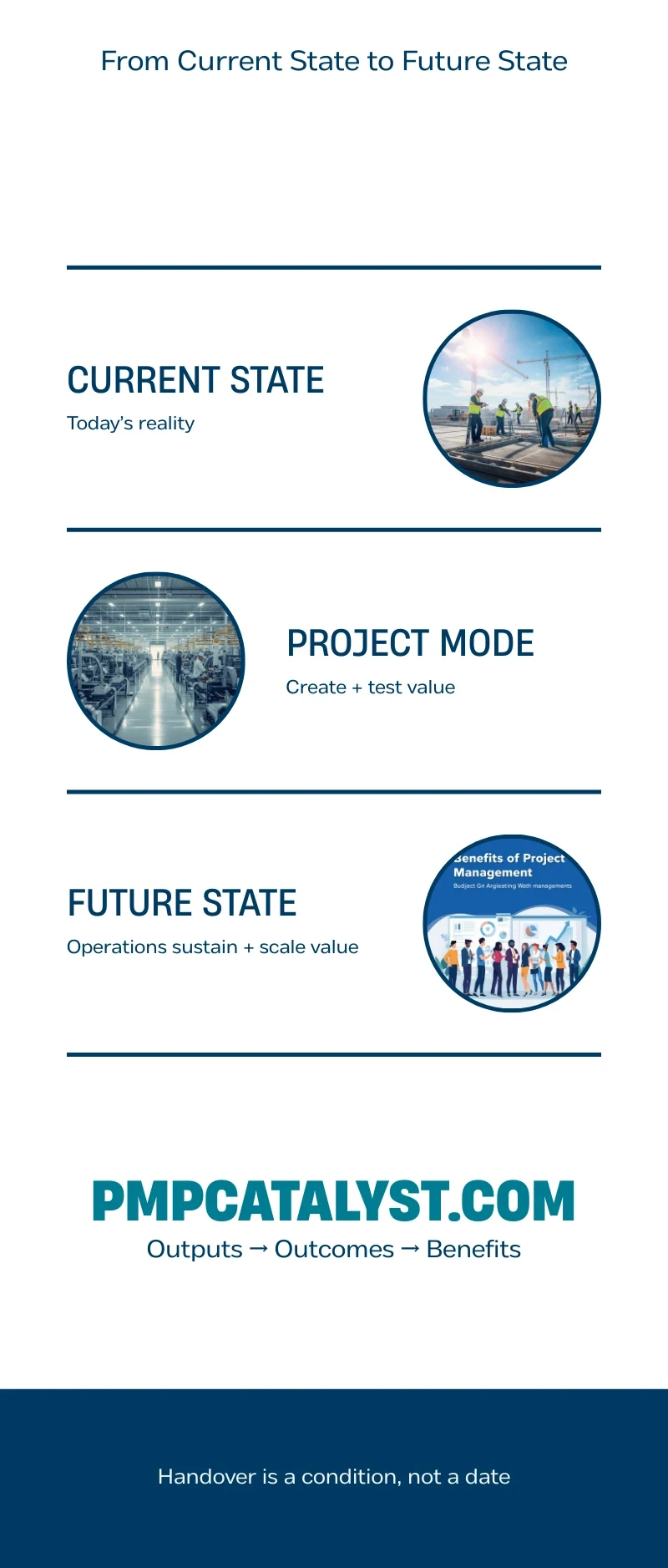
A project exists because the organization wants to move from a current state to a future state. That diagram you always see in the Standard such as in PMBOK 8 is not decoration (PMBOK 8’s shift toward value). It reminds us that projects produce outcomes that alter how the organization functions, and those outcomes must be sustained by someone after the project closes. There is a purpose behind it: something needs to change, something new must be created, or something old must be improved. The future state does not exist yet, and the project team is responsible for making it real. That is the essence of project management, and PMI repeats it for a reason. Projects are temporary, even if their deliverables persist long after. They have unique context: scope, risks, stakeholders, technology, constraints. They exist to drive organizational change and enable strategic objectives.
Operations, on the other hand, are different. They exist to produce, repeat, stabilize, and sustain. They are designed for flow, efficiency, and predictability and they carry the responsibility of keeping value alive after the transformation is complete. Operations management ensures efficient and reliable production, meeting demand with optimal cost, quality, and resources and running processes that do not have a defined end date. Operations are not about creating a new future state. They are about sustaining the current state and continuously improving it. Operations want fewer surprises. Projects are built on surprises. That is why they require different systems, different mindsets, and different leadership.
The confusion in manufacturing comes from the fact that our work never feels temporary. Even when we deliver custom CRAH units, the process looks similar. Even when we build a trainset at Alstom, we use the same stations in the factory. Even when we deploy a BESS container, the physical box resembles earlier models. The people doing the work often feel like they are “just doing their job”. Nevertheless, the units that look standard on paper do not feel standard when you unpack the details: different electrical requirements, airflow constraints, building codes, integration needs, site conditions, and the endless list of “small” deviations that change the entire game. PMBOK is very clear: similarity does not erase uniqueness. A project is defined by its specific goals, constraints, risks, and stakeholders, not by whether a product happens to look like last year’s model. PMI’s research is equally clear. Engineering to order is project work. The environment may resemble operations, but the management approach cannot be.
Here is where organizations trip. To understand why manufacturing blurs the lines in engineering-to-order industries, on one side the work never feels temporary as they see repetition on the surface and assume the underlying work belongs to operations. On the other side the manufacturing workflow itself feels like a project: New design, prototyping, procurement cycles, production planning, assembly and testing, packing and shipment, installation or commissioning, and warranty support. This is why some organizations default to “everything is a project” backed up by PMI that engineer to order is project work and similarity does not erase uniqueness. But that’s not accurate, and it creates real problems.
The truth is that manufacturing organizations need both project management and operations management. Not everything should live under the project umbrella and not everything belongs in operations either. Your portfolio or program is multiple projects until you deliver the contracted outputs, outcomes, and acceptance criteria whereas the manufacturing line that builds the units daily is operations. But the project is not done when the building is quiet. It is done when the future state exists.
With CRAH units, that future state is not a packaged or wrapped unit. It is a functioning cooling system delivering stable performance in the client’s data center within the expected parameters. With trains, the future state is not a locomotive leaving the assembly hall. It is a train integrated into the network, passes safety and performance tests, carrying passengers safely, reliably, and in accordance with whatever national safety authority governs the system. With BESS systems, the future state is integration with the grid and with verified performance curves. It delivers value when it charges, discharges, stabilizes the grid, and satisfies the utility’s operational constraints and a client who no longer feels they are running a prototype.
Your BESS installation is a project but the preventive maintenance plan on the deployed assets is operations. Your Alstom train delivery program is a project, but the depot doing recurring service and parts management is operations.
PMI’s value delivery system model explains this transition well. A project generates outputs. Those outputs generate outcomes. Outcomes lead to benefits. Benefits are sustained by operations, not by the project team. The project closes when the chain is ready to pass to the next link, not when a shipment milestone is achieved.
The danger is when you force project work through an operations mindset or vice versa. This is why you cannot run a manufacturing business on operations management alone. And it is also why you cannot treat everything as a project. Both are needed. The intelligence lies in knowing where one stops and the other begins, or when it overlaps and intersects.
Where the Two Disciplines Intersect (and Why It Matters)
PMBOK 8 highlights clear intersections where projects and operations intentionally exchange value: New product development feeding production, upgrades or process improvements that change how operations run, end-of-life transitions, and closeout phases where deliverables, knowledge, and responsibilities must transfer.
Manufacturing environments often struggle with the timing of the handover. They hand over based on internal pressure rather than the state of value delivery (Importance of Project Governance). They hand over when engineering wants to move on, when planning needs the hours back, or when margins look cleaner if the project manager is removed from the picture. But if the future state has not yet materialized, the project manager is still responsible, even if the Gantt chart says otherwise.
What PMBOK 8 adds, which many manufacturing organizations still overlook, is the emphasis on integration with operations long before the closing stage. It highlights the need to involve operations teams early, not as a formality but as part of achieving long term value. This includes early engagement during design decisions, clarity about what the operations team must sustain, and early visibility into risks that are likely to appear after commissioning. The Standard also reinforces the role of knowledge management. A project does not end with outputs delivered. It ends when the knowledge required to sustain those outputs has been fully transferred. Manufacturing companies often skip this part, and then wonder why the first year of warranty becomes a second project wearing an operational badge.
In manufacturing, the intersection points are typically: Production readiness (handover from design/engineering to manufacturability/production), shipment (handover from operations to field/service teams), installation and commissioning, warranty and service. These intersections are not afterthoughts, they are part of the value chain. If you miss these intersections, you create repeated rework, warranty costs, unclear ownership, angry customers, burnt-out teams. When you get them right, projects close cleanly, stakeholders get clarity, and operations teams can sustain value without firefighting.
Where Manufacturing Complicates the Picture
In many industries, once you ship a product, your project is done. But if you work with CRAH units, trains, or energy storage systems, you know that shipping is only one milestone. It is not the finish line. The real work continues afterward. Units are unpacked. They are installed. They are connected to systems that never exist the way the drawings suggested. They are commissioned. They pass or fail SAT. They run into the realities of a job site that rarely respects theory. And if anything goes wrong during warranty, the client does not care if the issue belongs to the project or to operations. They just want someone to fix it.
This is the moment where companies get hurt. They hand over too early. They hand over without clarity. They hand over because someone wants the project manager off the books, even though the future state has not been reached. And that always comes back to bite them.
I have seen projects closed on paper while engineering was still redesigning components. I have seen production move on while field teams were improvising solutions that were never part of the contract. I have seen deployments where warranty support became a second project disguised as “ongoing operations” simply because nobody wanted to admit that the original project was never truly closed.
So When Should the Project Transfer to Operations?
When value is still being created and tested, you are still in project mode. When value is being sustained, you are in operations. PMBOK 8 uses this idea as a practical north star. Reality is messier, but organizations should not overcomplicate the basic distinction.
Project managers always ask when do we officially hand over. At shipment? At SAT? At the end of warranty? There is no universal timestamp, but there is a universal principle: The handover to operations happens when the project has delivered its contracted outputs and outcomes, and operations can sustain value without depending on project-specific resources.
The moment of handover should not be a date. It should be a condition. It is the moment where the work ahead becomes repeatable rather than unique. It is the moment where remaining activities are governed by operational processes rather than project processes. It is the moment where sustaining value becomes more important than creating it.
In practical terms, you know you are still in project mode when you are dealing with design questions, unverified performance, site integration issues, commissioning uncertainty, SAT failures, or anything that requires problem solving rather than execution of a stable routine. You know you are approaching operations when the equipment runs as intended, variations are understood and manageable, and the remaining work can be delivered through established operational workflows. It happens at stability. If stability is not there, the project is not done.
Until this moment, you are not done. You are transitioning. And transitions belong to projects, not operations. Once the system is running, once outcomes have been achieved and the remaining work is repeatable, predictable, and stable, then it is time to hand over. Not before.
Use this decision logic instead of dates:
- Has the project delivered the defined outputs? Equipment manufactured, tested i.e. FAT, packed/wrapped, documentation competed. If not, the work is still project work.
- Has the equipment delivered the initial outcomes on site? Installed, commissioned, successfully passed SAT. If not, you are still in project mode, even if the physical product is out of your factory, but that doesn’t mean the same project management team should continue to take the lead.
- Is the organization transitioning into “sustain” rather than “create”? Operations take over when: Remaining work is recurring, predictable, or service-based, no engineering design changes are expected, the customer relationship shifts from delivery to support. Retrofits, corrective actions, or engineering changes are usually still project work, not operations.
- Is ownership documented and accepted? A true handover requires: Stakeholder signoff, updated documentation, knowledge transfer, assignment of operational KPIs (performance, reliability, MTBF, etc.). If operations cannot demonstrate they have the knowledge, capacity, and ownership to sustain the asset…the project is not closed. Period.
If any of these conditions are missing, the handover is premature. It might satisfy an internal target, but it will not satisfy the real measure that PMI emphasizes. The future state must be reached.
The Cost of Handing Over Too Early
Every time I have seen a project handed over early, the same story unfolds. A problem appears on site. A commissioning step reveals a gap. A retrofit is required. The warranty team is caught in the middle. And everyone suddenly asks who should handle it, as if the question was not predictable from day one. In my experience, unclear ownership is one of the fastest ways manufacturing projects bleed money, not because the issues are complex but because nobody agrees on who should resolve them.
Manufacturing companies often transfer ownership too early. Premature handover damages value. In manufacturing, teams are often pushed to hand over too early to clean up the books by freeing up engineering, production, or field resources for the next priority. But resourcing is not the only driver. Sometimes the pressure comes from performance domains: Executives want to reduce project costs and hours. They move a struggling project into operations allowing them to make overruns and delays harder to see (EVM makes overruns visible), reset KPIs, or shift the narrative from delivery performance to “business as usual.” In the worst cases, the timing aligns with reporting cycles and incentive structures, where declaring “done” protects targets, protects reputations, and can even protect bonuses.
But the equipment is still undergoing installation, commissioning, and site acceptance. The client is still working through integration constraints. Engineering is still answering questions. The system has not stabilized. The future state is not yet real. The result is predictable: unresolved defects, incomplete commissioning, unclear ownership, and value that erodes after the transition to operations.
Every project manager has experienced this. Every time a handover happens at this stage, the same issues appear. Unplanned rework. Last minute retrofits. Confusion about who answers the client’s calls. Operations taking on engineering changes that belong to the project. Project managers being dragged back into work they supposedly closed weeks earlier.
In fact, you hand over the project because you were told to close it but a month later you receive a call from the site because a component failed and nobody knows whether the fix should be designed by engineering, executed by operations, or escalated back to you. Suddenly your “closed” project is alive again. This happens because the handover was symbolic, not real.
This is why premature handovers are so costly. They break the chain between outputs and outcomes in the PMI value delivery system. They disrupt benefit realization. They force departments to argue about ownership rather than focus on the client.
PMBOK warns clearly: Closing is not about stopping work. Closing is about verifying outputs, outcomes, and benefits, and confirming the future state is reached. If the future state is not reached, you are not done. You are abandoning the project early.
A real handover requires something deeper. It requires clarity on responsibilities, confidence from the receiving team that they can sustain the product, knowledge transfer that is not rushed or superficial, verification that the intended value has actually been realized. If these elements are missing, you are not handing over. You are abandoning the project mid-flight. When that happens, organizations pay the price through warranty overruns, customer dissatisfaction, unplanned engineering hours, and internal friction that slowly erodes morale.
What Project Managers Should Do Differently
If you want cleaner project closures and fewer escalations after delivery, you need to treat handover as a critical milestone, not a formality. Engage operations earlier. Explain the unique context of the project. Document what is still unstable. Make sure people accept their responsibilities rather than have responsibilities assigned to them without conversation. Share what went wrong, not just what went right. Capture knowledge deliberately before everyone runs to the next urgent priority.
And most importantly, define the end of the project based on outcomes, not internal convenience.
When the project has achieved what it promised, you can close with confidence. When the organization has reached the new future state, operations can sustain it calmly. That is when everyone wins.
Here is a best practice checklist for clean handover to operations: Use this checklist before you declare a project closed.
Project Completion Criteria:
- All outputs delivered (as per contract and specs)
- Engineering changes closed or formally transferred
- All tests passed (FAT, SAT)
- Required documentation delivered and accepted
- Knowledge captured (Manage Project Knowledge)
- Lessons learned completed
Operational Readiness Criteria:
- Operations/service teams trained and resourced
- Maintenance plans and spare parts strategy in place
- Ownership of KPIs assigned
- Support processes confirmed (ticketing, escalation, response times)
- Remaining work is predictable and recurring
Business Value Criteria:
- Customer accepts the product or solution
- Value has begun to be realized (future state reached)
- Residual risks documented and owned by operations
If these boxes are not checked, the handover is premature.
What This Means for You as a Project Manager
If you manage industrial projects, then you already know that handover is one of the most sensitive moments in the life of a project. It is where value is either protected or lost. It is where confidence is either built or broken. Your job is not to deliver equipment and disappear. Your job is to ensure the organization or the client reaches the future state. Hence, don’t see handover as a paperwork ritual. See it as one of the most critical moments of value protection.
If you want smoother project closures, fewer escalations during warranty, and a more predictable manufacturing environment overall, then you need clarity. This means you must clarify roles and responsibilities long before the unit leaves the factory. It means defining transfer points in the scope statement and the schedule, not letting them appear by accident. It means you ensure the knowledge created by the project is captured before it evaporates, rather than discovering later after people have moved on. It means protecting the distinction between project work and operational work so nobody inherits work they cannot support. You need to define the conditions of project completion based on outcomes, not internal convenience.
Most important, you need to remember the image from PMBOK. The project moves the organization from one state to another. Operations protect the new state once it is reached. If the new state is not yet real, then the handover is an illusion, and the weight of that illusion always falls back on the project manager.
Strong project managers engage operations early, clarify ownership long before shipment, define transfer points in the SOW and schedule, capture knowledge and lessons proactively, and protect the distinction between temporary and ongoing work. They draw the line clearly so that organization gains strength. When executive leadership is weak, the line gets blurry. The organization absorbs the cost through stress, late-night calls, escalations, and all the invisible hours that never make it into the timesheet.
Can Manufacturing Organizations Survive Without Project Management?
Some leaders still believe project management is an administrative luxury or overhead. “Why can’t operations just handle it? We build similar units anyway.” You and I know the truth. Operations are not designed for custom engineering, scope interpretation, risk management, contract negotiation, customer-facing change decisions, or complex commissioning cycles.
Here is the reality, backed by PMI standards and decades of manufacturing experience.
Operations management cannot support what PMI defines as temporary, uncertain, and context driven. It cannot handle custom engineering requirements. It cannot navigate stakeholder alignment in complex contracts. It cannot manage scope interpretation or change control. It cannot protect the organization from the risks that appear when equipment must operate in environments that never match the drawings. It cannot manage commissioning conditions that require technical judgment rather than routine execution. It cannot absorb warranty defect analysis when those defects trace back to design decisions made during the project.
Operations excel at efficiency and repeatability. Projects are about uniqueness and transition. They require different systems, different thinking, and different accountability.
Without project management, manufacturing companies suffer from low margins caused by uncontrolled rework, scope creep disguised as “customer requests”, unclear ownership, engineering departments drowning in uncontrolled changes, missed deadlines, cost overruns, documentation chaos, dysfunctional communication between departments, and escalating customer frustration or poor customer experience. The cost is not theoretical. You see it every week in the form of delays, fire-fighting, and all the hours wasted trying to fix what should have been clarified earlier. You have seen this with CRAH units that return for rework, with rolling stock that enters service late, and with BESS systems that require months of site tuning because nobody defined the boundary between the unique and the repeatable.
When project and operations each play their true role, value flows. When they overlap without clarity, people burn out, customers complain, and organizations pay for the same mistake more than once.
If you work in a manufacturing industry, you already know this: You cannot scale a profitable business without project discipline. Operations can deliver stability. Only project management can deliver transformation. These are not interchangeable.
Project managers exist to protect value. Operations exist to sustain it. Mixing the two wastes both.
Closing Thoughts
Manufacturing companies live in a world where every delivery looks familiar, yet every delivery carries its own context. This is why project management is not optional. It is the mechanism that carries the organization from uncertainty into clarity. You see it every day. New designs. New requirements. New constraints. New risks. No two deliveries ever feel identical. That is the nature of our work. Manufacturing companies deliver value through projects even when they forget they are doing projects.
Operations are critical for they keep the business alive and preserve the value, but projects are what move the business forward and create value. If you want fewer escalations, fewer late-night calls, fewer “who owns this?” debates, then draw the line clearly.
The question is not whether you need both project management and operations. You do. Project work creates value. Operations sustain it. Both matter but they are not the same. The question is whether you draw the line with intention, clarity, and respect for the value chain. When the line is clear, everyone breathes easier. When it is blurred, the entire system absorbs the cost.
Knowing exactly when to move from one to the other is one of the marks of a mature project organization.
If you found this helpful and want more clarity on project performance, planning discipline, or PMP exam mastery (How PMP certification boosts your career), feel free to connect. I write for project managers who want more control, more confidence, and more impact in the way they deliver work.